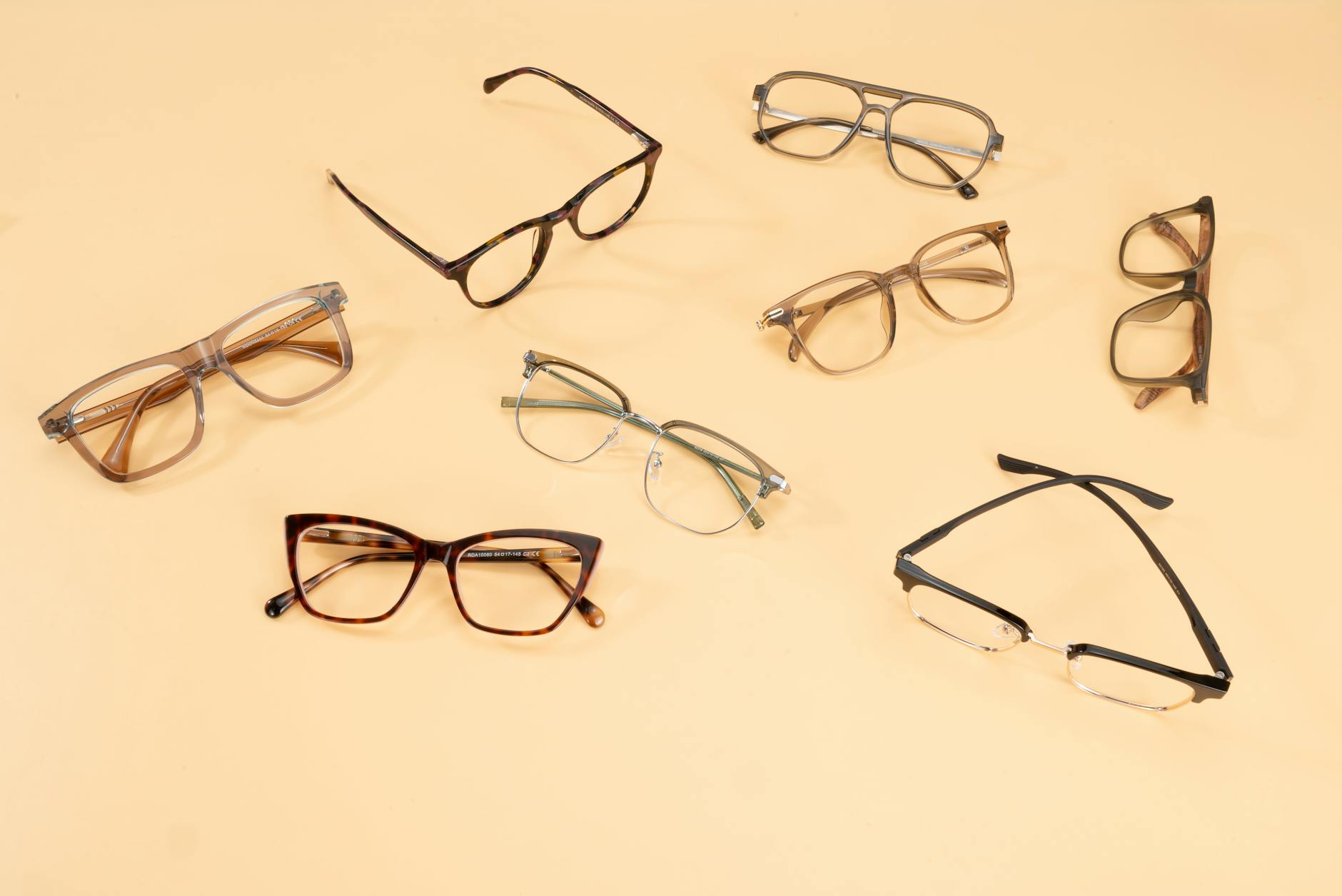
Quick Answer: To choose glasses for your face shape, identify whether your face is oval, round, square, heart, or oblong — then pick frames that create balance. Oval faces can wear almost any shape. Round faces suit angular frames. Square faces look best with rounded or oval frames. Heart faces balance with wider-bottom frames. Oblong faces suit oversized or wide frames.
Walk into any optical shop and the hardest question you'll face isn't the prescription — it's "which frames suit me?" Most people spend twenty minutes trying on pair after pair with no clear framework for what they're looking for.
The answer starts with your face shape. It's not a rigid rule system, but it's the single most useful filter for narrowing a wall of frames down to the handful that'll actually work for you. Here's exactly how to use it.
How to Identify Your Face Shape
Stand in front of a mirror and pull your hair back so your full face is visible. Look at the overall outline, then consider:
- Forehead: Is it wide or narrow relative to your jaw?
- Jaw: Is it angular/squared, rounded, or pointed?
- Cheekbones: Are they the widest part of your face?
- Face length: Is your face longer than it is wide, or roughly equal?
Alternatively, trace your reflection on the mirror with a dry-erase marker or lipstick, then step back and look at the outline. Most people fall into one of five categories.
The 5 Face Shapes and Best Glasses for Each
Oval Face Shape
Characteristics: Slightly wider at the cheekbones, gently narrowing at the forehead and jaw, face length about 1.5x the width.
The good news: Oval is considered the most versatile face shape for glasses — almost any frame style works. The natural balance of an oval face means you can experiment freely.
Best frames for oval faces:
- Rectangular and square frames add structure without overpowering
- Classic wayfarers and club masters are reliable standards
- Oversized frames work well without overwhelming features
- Avoid frames that are too wide or too narrow relative to your face width — the goal is proportion, not shape matching
Frame picks to try: Ray-Ban Wayfarer, Warby Parker Durand, Oakley Holbrook
→ Browse rectangular frames on Amazon
Round Face Shape
Characteristics: Similar width and length, soft curved features, full cheeks, rounded jawline with little angularity.
The goal: Add angles and definition to elongate the face and create structure. Angular frames create visual contrast with rounded features — the result is a face that appears longer and more defined.
Best frames for round faces:
- Rectangular frames are the classic choice — the hard corners elongate the face
- Square frames work similarly, adding structure at the temples
- Geometric shapes (hexagonal, octagonal) add angular interest
- Avoid round or circular frames — they echo the roundness of your face rather than balancing it
- Avoid small frames that get "swallowed" by fuller features
Frame picks to try: Warby Parker Percey, Ray-Ban RX5228, EyeBuyDirect Contour
→ Browse angular eyeglass frames on Amazon
Square Face Shape
Characteristics: Broad forehead, wide jaw roughly equal in width to the forehead, strong defined jawline, minimal width variation top to bottom.
The goal: Soften the angles and add length. Rounded frames counterbalance the sharpness of a square face — the face appears longer and less blocky.
Best frames for square faces:
- Round and oval frames are the primary recommendation — they soften strong jaw angles
- Rimless or semi-rimless frames reduce the visual weight of the frame, making features look less heavy
- Narrower frames add perceived length
- Avoid boxy, squared frames — they compound the angularity of a square face
- Avoid frames that are overly wide at the temples, which emphasize face width
Frame picks to try: Ray-Ban RB3016 Clubmaster, Warby Parker Begbie, Moscot Lemtosh
→ Browse round and oval frames on Amazon
Heart Face Shape
Characteristics: Wider forehead and temples, prominent cheekbones, narrow chin — the face tapers significantly from top to bottom, like an inverted triangle.
The goal: Balance the wider upper face by drawing attention downward and adding visual width at the lower portion. Frames should be wider at the bottom than the top.
Best frames for heart faces:
- Bottom-heavy frames (wider at the lower rim) are the classic recommendation — they visually widen the chin area
- Round and oval frames balance the pointed chin effectively
- Light-colored or rimless frames at the top reduce attention to the forehead
- Avoid aviators and cat-eye frames that emphasize the upper face and temples
- Avoid heavy frames overall — they can overwhelm the narrower lower face
Frame picks to try: Warby Parker Barnett, EyeBuyDirect Butterfly styles, Zenni round frames
→ Browse lightweight oval frames on Amazon
Oblong (Rectangle) Face Shape
Characteristics: Longer than it is wide, relatively consistent width from forehead to jaw, minimal width variation across the face's length.
The goal: Add width and reduce the perceived length of the face. Wide frames create horizontal emphasis that makes a long face appear more balanced.
Best frames for oblong faces:
- Wide frames are the priority — they add width and reduce the face's elongated appearance
- Oversized frames work well, adding presence across the face
- Deep (tall) frames shorten the apparent length of the face
- Decorative temples (the arms of the glasses) add width at eye level
- Avoid narrow, small frames — they emphasize the length of the face
- Avoid frameless designs, which reduce visual width
Frame picks to try: Ray-Ban Clubmaster Oversized, Warby Parker Baxter, large-format wayfarers
→ Browse wide oversized frames on Amazon
Beyond Face Shape: The Other Factors That Matter
Face shape is a useful starting filter, but it's not the only one. Once you've narrowed to frame shapes that should work, consider:
Frame Width vs. Face Width
Regardless of shape, frame width should roughly match your face width. Frames that extend well past your temples look oversized; frames significantly narrower than your face look pinched. Most frame specs list a total width measurement — match it to the width of your face at the cheekbones.
Pupillary Distance (PD)
Your PD — the distance between the centers of your pupils — should fall near the center of each lens. If you're ordering glasses online, measure your PD first (your optician can provide it, or measure it yourself with a ruler and mirror). Mismatched PD and lens center causes optical distortion, regardless of how good the lenses are.
Skin Tone and Frame Color
Warm skin tones (yellow/olive/golden undertones) suit warm frame colors: tortoise, gold, warm brown, olive. Cool skin tones (pink/blue/purple undertones) suit cool frames: silver, black, gunmetal, cool-toned tortoise. Neutral tones can go either way — classic black and clear frames are universally safe.
Lifestyle Fit
A beautiful thin acetate frame won't survive an active outdoor lifestyle. If you're physically active, prioritize frames with spring hinges, grippy nose pads, and impact-resistant lenses. If you're primarily desk-bound and on video calls, lighter weight and aesthetic versatility matter more than durability specs.
Frequently Asked Questions
Can I wear any glasses style if I like them?
Absolutely. Face shape guidelines are a starting point, not a rule. Plenty of people wear frames that technically "don't match" their face shape and look great — because fit, confidence, and personal style matter as much as geometry. Use the guidelines to help you narrow options quickly, then trust your eye.
What face shape suits aviator sunglasses?
Aviators work best on oval and oblong faces. The teardrop shape adds width and the thin metal frame keeps things from looking heavy. They can work on square faces too, where the rounded lower curve softens angular jaws. They're less flattering on heart-shaped faces (they emphasize upper face width) and round faces (the curved bottom lens adds roundness).
How do I try on glasses if I'm buying online?
Most major online eyewear retailers offer virtual try-on (Warby Parker, Zenni, GlassesUSA, EyeBuyDirect all have this). You use your phone camera to see frames overlaid on your face in real time — it's not perfect, but it's genuinely useful for filtering out shapes that clearly don't work before ordering. Many also offer home try-on programs where you can physically test 5 frames before committing.
Do glasses look different in person than on a model?
Yes — always. Models are selected partly because most frames look good on them. Pay more attention to frame measurements (width, lens height, bridge width, temple length) than how a frame looks on a model who may have different proportions than you. Most quality retailers list all four measurements and sometimes provide a fit guide.
Start With Shape, Finish With Fit
The face shape guide cuts the overwhelming selection of frames down to a manageable shortlist. From there, it comes down to fit (width match, bridge comfort, temple length), lifestyle (how durable do you need them?), and ultimately personal taste.
The best glasses are the ones you'll actually wear — because they look good, feel comfortable, and hold up to your life. Start with your face shape, let it guide you to the right shortlist, and trust yourself from there.